Coach Continuity in Swim Classes: Why It Matters for Your Child
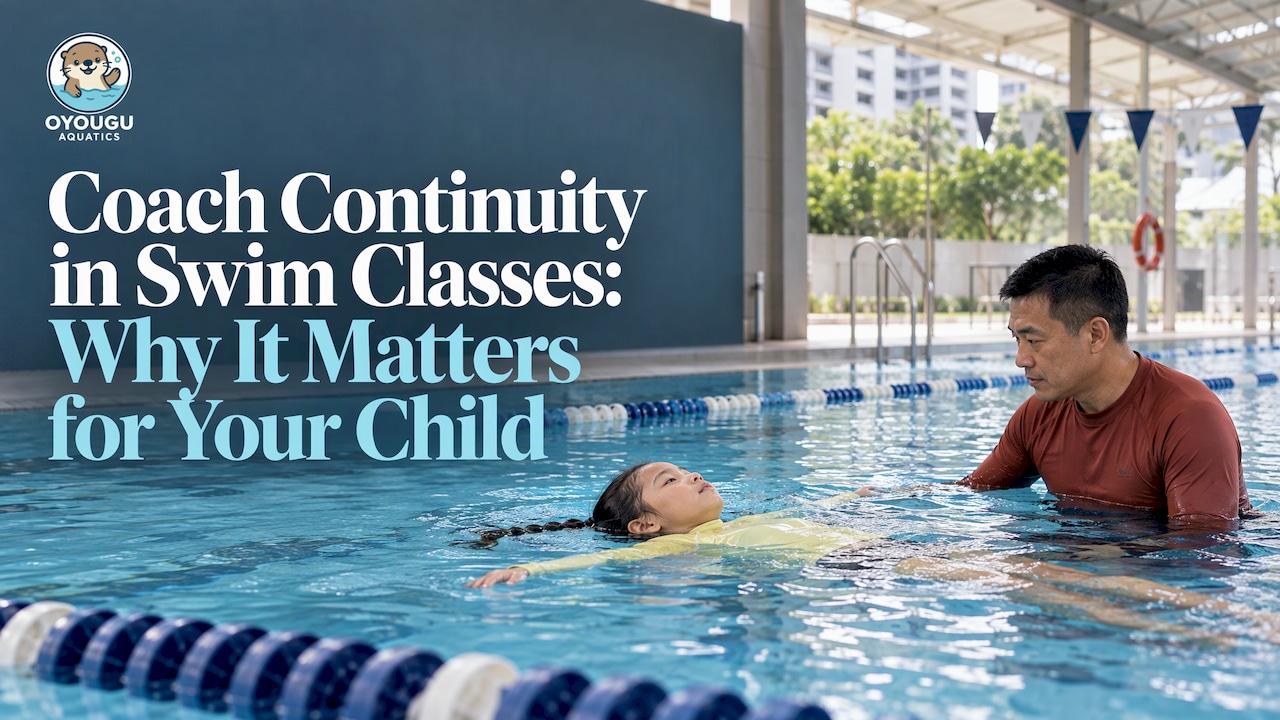
Why the same coach from lesson to lesson helps your child's progress, confidence and safety in Singapore, and how to watch lessons without disrupting them.
Coach Continuity in Swim Classes: Why It Matters for Your Child
A child learns to swim one foundational skill at a time, and the adult who guides each step matters as much as the pool. When the same coach teaches your child week after week, that coach knows which skills are secure, which still make your child nervous, and what to try next. At Oyougu Aquatics, our classes are developed in-house and taught by our own full-time coaches, never outsourced, and capped at 6 children per class, so your child is taught by people who know the lesson plan and know your child.
OyouguAquatics
Choose Coaching That Knows Your Child
Oyougu Aquatics teaches children in small classes with in-house coaches, supporting personal attention as they build swimming skills.
Visit
Key Takeaways
A coach who stays with your child can build on yesterday’s lesson instead of re-assessing from scratch, which keeps progress steady and confidence high.
In Singapore, SwimSafer 2.0 is the national framework: six stages, 12 hours of lessons per stage, with an assessment at the end of each. Continuity helps your child arrive at that assessment prepared.
Small classes make continuity real. Our ratio is 1 coach to 6 students, tighter than the 1:10 ratio stated in the SwimSafer 2.0 Instructor’s Manual.
You can check a coach’s standing: coaching in ActiveSG pools requires NROC registration and completion of SwimSafer.
Watching lessons is part of good learning for a parent, as long as you stay out of the coaching.
Table of Contents
Why the same coach makes a difference
How SwimSafer 2.0 rewards a coach who stays
Class size decides whether a coach can really know your child
Checking a coach’s credentials
What good coaching looks like week to week
Watching your child’s lessons without disrupting them
Making continuity work across our pools
Start with a trial lesson
Our view: progress is built by people who stay
FAQ
Sources
Why the same coach makes a difference
Swimming is physical, but for a young child it is also emotional. Putting your face in the water, letting go of the wall or floating on the back all ask a child to trust someone. Trust builds with familiarity. A child who sees a new face each week spends part of every lesson getting used to the adult instead of the water.
Continuity helps in three practical ways:
The coach remembers. Which child needs a hand held through back floats, which one rushes kicks and loses form, which one goes quiet when worried. Small details like these decide how a coach words an instruction.
Lessons connect. Swimming skills stack. Breathing rhythm leads to floating, floating to kicking with support, kicking to short unaided swims. A coach who taught last week’s step knows exactly how secure it is before adding the next.
Feedback to you is specific. “She is ready to try the next skill” is more useful than a general comment, and it can only come from someone who has watched your child repeatedly.
The bigger reason to care is safety. Singapore’s national programme exists first of all for drowning prevention, according to the Ministry of Culture, Community and Youth . A December 2025 systematic review of 33 studies in Frontiers in Public Health found case-control evidence of a statistically significant reduction in drowning deaths among children aged 0 to 4 who had formal swimming skills training, though with low certainty. Formal, structured lessons are the point. Consistent coaching is how that structure is delivered, lesson after lesson.
How SwimSafer 2.0 rewards a coach who stays
SwimSafer is Singapore’s national water safety programme. It has six progressive stages, and according to the MCCY’s 2021 parliamentary response , each stage is made up of 12 hours of lesson time, with assessment in the last session of the stage. Assessors follow a standard list of criteria and do not assess their own students.
That last point is worth understanding. Your child’s own coach teaches and prepares, and a separate assessor judges. So the coach’s job is to know, before assessment day, exactly where your child stands against the criteria. The SwimSafer 2.0 block plan updated in July 2025 sets clear goals along the way:
Stage
What the plan aims for
Stage 2
25 metres of continuous swimming
Stage 3
50 metres of continuous swimming
Bronze
100 metres of a variety of strokes
Silver
200 metres of varied strokes within a time frame, diving fundamentals and a sinking-boat survival scenario
Gold
400 metres per stroke within a time frame, plus survival skills such as making a flotation device from clothing
Over 12 hours, a lot happens: a child who could not float on day one is swimming a length by the end. A coach who has been there for all of it can judge honestly when your child is ready to be assessed, and can focus the last lessons on the one criterion still missing instead of repeating everything.
The national CAMS Handbook (July 2025) adds a reason for a close coach relationship. Each stage needs a practical assessment passed at 100% competent plus an online theory quiz with a 90% pass mark, and registrations made by parents must be validated by the recognised SwimSafer coach tagged to your child. The coach who knows your child’s readiness is the one who confirms the booking. If you would like to see how this process runs for parents, our SwimSafer assessment guide walks through it, and our overview of the six SwimSafer 2.0 stages shows what each stage asks of your child.
Class size decides whether a coach can really know your child
Continuity only works if the coach has the attention to notice things. In a crowded lane, even a long-serving coach cannot watch every child’s kick.
The SwimSafer 2.0 Instructor’s Manual (March 2018) states an instructor-to-student ratio of 1:10, and tells instructors to consider students’ characteristics and reduce class size or add a co-instructor where needed. It also asks instructors to use teaching approaches suited to each student’s experience and ability.
We set our own limit lower. All our classes are capped at 6 students, which gives each child more of the coach’s eyes and voice in every session. In a group of six, a coach can correct one child’s arm position, praise another’s first unaided float and still keep everyone safe. Our page on the best small group class size for swimming lessons explains the thinking in more detail.
Checking a coach’s credentials
A consistent coach is only valuable if the coach is properly qualified. In Singapore, the rules are clear. ActiveSG’s Rules and Regulations (Rule 40) allow swim coaching in its swimming complexes only with a usage permit from ActiveSG, registration as an instructor on the National Registry of Coaches (NROC) and completion of the SwimSafer national water safety programme.
Sport Singapore’s 2018 announcement on SwimSafer 2.0 adds that instructors recertify every three years with mandatory continuous coach education hours, so that their content knowledge and teaching practices stay current.
Our coaches are NROC and SwimSafer certified, full-time, and bring over 10 years of experience. That combination matters for continuity: a full-time coach is someone your child can expect to see term after term. For a full checklist of what to look for, see our guide to swim coach qualifications in Singapore .
What good coaching looks like week to week
You do not need to be a swimmer to recognise a coach who knows your child. Look for these signs:
The lesson starts where the last one ended. Your child goes straight into a familiar drill instead of a general warm-up for everyone.
The coach uses your child’s name and specific cues. “Chin in the water, like we practised” shows memory of earlier lessons.
Skills are named and measurable. “She can now float on her back for ten seconds” beats “she is doing well”.
Worries are noticed. A good coach adjusts the pace for a child who is anxious, rather than pushing on.
Your child moves up when ready, not before. Progress follows skills, with no hurry and no pressure.
The coach explains the next goal to you. At the end of a stage, you should know which stage comes next and what it asks of your child.
A missed lesson should not break the chain either. We offer flexible makeup classes, so a sick week does not leave a gap in your child’s learning.
Watching your child’s lessons without disrupting them
Most parents want to see their child in the water, and that is natural. A few habits help your child and the coach:
Stay in the viewing area and let the coach lead. Calling instructions from the side confuses a child who is already listening to one voice.
Watch for the small wins. A calmer face in the water, a longer breath out, a straighter kick. Note them and tell your child afterwards.
Save questions for after the class. The coach’s attention during the lesson belongs to the six children in the water.
Keep to the pool’s safety rules. ActiveSG’s Rule 26 says children aged 6 and under must be accompanied by, and kept within arm’s reach of, an adult who is always responsible for the child’s safety in the swimming complex. Rule 28 requires everyone to leave the pool and open areas during lightning or hazardous weather when staff instruct.
Assessment day is different. According to the CAMS Handbook , at Stage 6 assessments participants go to a holding area while parents and guardians go to a designated holding area, and parents and coaches must not talk to or engage the assessor while the assessment is in progress. A parental consent form must be completed beforehand, and participants arriving after the assessor’s safety briefing has started cannot continue. The recommended minimum age for SwimSafer assessment is six years. Plan to arrive early and give your child a calm, encouraging send-off.
Making continuity work across our pools
Our lessons run at ActiveSG pools including Bishan, Delta, Jalan Besar and Teck Ghee (Ang Mo Kio), so most families can pick a pool near home or school and keep the same weekly slot. A regular slot at one pool is the simplest way to keep your child with familiar coaches and classmates. If you live around Bishan, our page on swim classes at Bishan Swimming Complex gives the details.
To make the most of continuity:
Choose one pool and one weekly time, and keep to it where you can.
Tell the coach about anything new, such as a cold, a scare in the water or a change in your child’s mood.
Let the coach set the goal for the next few weeks, and ask what practice at home, such as blowing bubbles in the bath, would support it.
Start with a trial lesson
If you are choosing a swim school, the best way to see how a coach works with your child is to put your child in the water. Our trial lesson costs S$32.50 one-off. After that, our small group classes, children’s swimming lessons (ages 3 to 12) and toddler swimming lessons are S$130 per month, with no registration fees or deposits. Private classes are also available, and you can see the options on our fees page .
You can book a trial lesson and meet the coach who would teach your child.
Our view: progress is built by people who stay
We believe a child’s confidence in the water is built by a coach who knows them, and that starts with how a swim school is organised.
That is why our classes and curriculum are developed in-house and we do not outsource our classes. Our coaches are full-time, NROC and SwimSafer certified, with over 10 years of experience. They teach the national SwimSafer 2.0 curriculum, one foundational skill at a time, and they know what each of the six children in their class can do and what comes next.
Class size is part of the same promise. We cap every class at 6 students because attention is what keeps a child safe and encouraged. We keep the cost clear too: S$130 a month, with no registration fees or deposits.
When your child feels known by their coach, they relax, listen and try again. That is the kind of progress we want for every family.
Oyougu Aquatics
FAQ
Does my child need to keep the same coach to pass SwimSafer?
No rule says so, but familiarity helps. Each SwimSafer stage is 12 hours of lessons, and a coach who has taught your child through those hours can judge readiness accurately. Your coach also validates your child’s assessment registration, so a coach who knows your child’s progress is the best person to do it.
Can I watch my child’s swimming lesson?
In most cases you can watch from the pool’s viewing areas, and your presence reassures many children. Children aged 6 and under must stay within arm’s reach of an accompanying adult in ActiveSG pools. Keep instructions to the coach and save questions for after the class.
How do I know my child’s coach is qualified?
In ActiveSG swimming complexes, coaches need a usage permit, NROC registration and completed SwimSafer training. Our coaches are NROC and SwimSafer certified. Our guide to what to check in swim coach qualifications lists the points in more detail.
What happens if my child misses a lesson?
We offer flexible makeup classes, so a missed lesson does not leave a gap in your child’s learning. Let your coach know in advance, and they can pick up where your child left off.
Sources
Frontiers in Public Health: basic swimming or water safety skills training and drowning (2025)
MCCY: Efficacy of SwimSafer programme
SwimSafer 2.0 Instructor’s Manual Block Plan (July 2025)
SwimSafer CAMS Handbook (July 2025)
SwimSafer 2.0 Instructor’s Responsibilities extract
ActiveSG Rules and Regulations
Sport Singapore: SwimSafer to improve Singaporeans’ swimming competency
Recommended
Swim Lessons through Water Play: Why Every Child Needs Them and How Parents Can Be Involved
Dive into Learning: Coach Jimmy Answers 5 Key Questions on Teaching Your Child the Basics of Swimming
The Benefits of Engaging a Full-Time Coach Certified by National Registry of Coaches (NROC)
10 Questions to Ask When Choosing Swimming Lessons for Kids