SwimSafer Stage 2: What Your Child Learns and Is Tested On
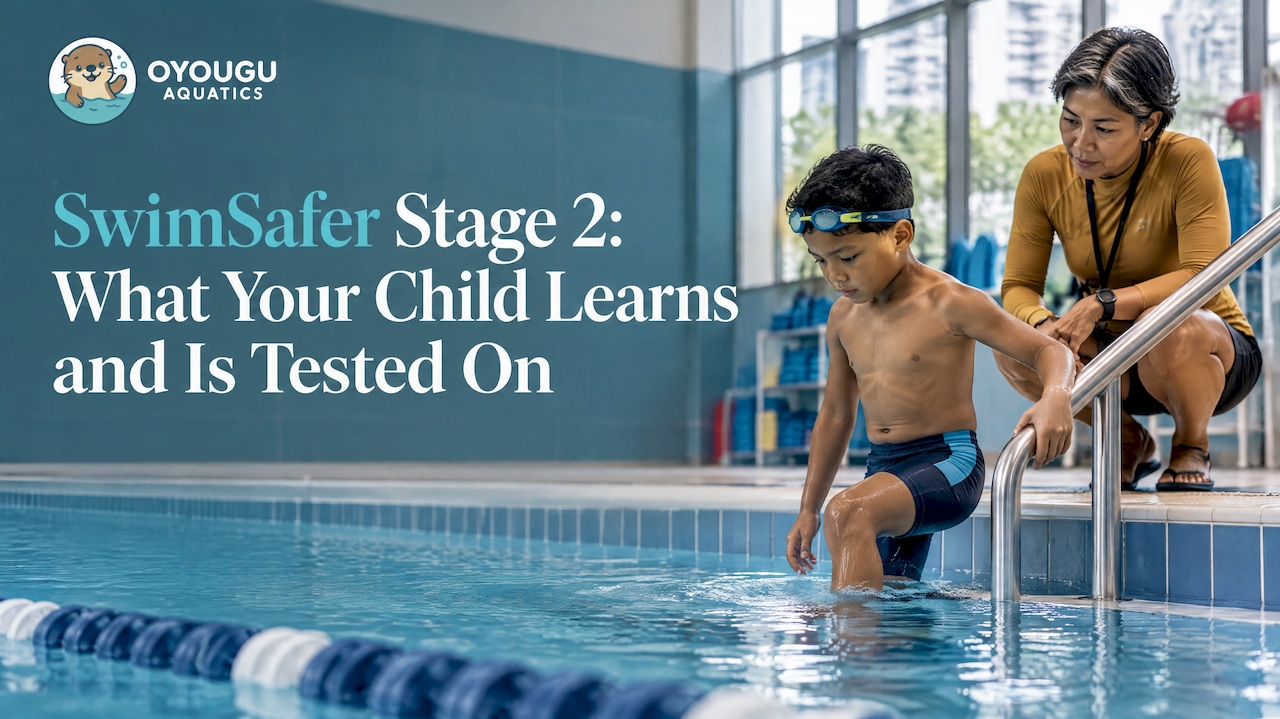
A parent's guide to SwimSafer 2.0 Stage 2 in Singapore: the skills, the 25m swim, how the practical and quiz work, and how to prepare your child calmly.
SwimSafer Stage 2: What Your Child Learns and Is Tested On
SwimSafer 2.0 Stage 2 is the point where your child moves from first water confidence to real fundamental water skills: stepping into the pool unassisted, floating for longer, sculling, a feet-first surface dive and a goal of 25 metres of continuous swimming. This guide explains each skill, how the assessment and online quiz work, and how to prepare your child without pressure. At Oyougu Aquatics we teach the SwimSafer 2.0 curriculum in groups capped at six children, so each child gets the attention these skills need.
OyouguAquatics
Build Your Child’s SwimSafer Skills
Oyougu Aquatics teaches the SwimSafer 2.0 curriculum in groups capped at six children, supporting focused practice of fundamental water skills.
Visit
Key Takeaways
Stage 2 is called Fundamental Water Skills. It builds on Stage 1 with step-in entry, 10-second floats, 25m of movement on the front and 15m on the back.
Each stage has a practical assessment (100% competence in the must-see skills) and an online theory quiz (90% or higher). The quiz must be passed within seven days of the practical.
Results appear on the assessment system within 48 hours, and the e-certificate is released only after both parts are complete.
Calm, regular practice and a low coach-to-student ratio matter more than rushing to the test.
Our group classes cost S$130 per month with no registration fee, and a trial lesson is S$32.50.
Table of Contents
What SwimSafer 2.0 is, and where Stage 2 sits
What your child learns in Stage 2
What these skills look like for a child
How the Stage 2 assessment works
How to prepare your child for Stage 2
Why class size changes how Stage 2 goes
Starting Stage 2 lessons with Oyougu Aquatics
Our perspective
FAQ
Sources
What SwimSafer 2.0 is, and where Stage 2 sits
SwimSafer is Singapore’s national water-safety programme. It was introduced in July 2010 by the National Water Safety Council and enhanced in 2018 with a revised syllabus and assessment criteria. Today’s SwimSafer 2.0 has six progressive stages, and an e-certificate is issued when a child completes each one.
Singapore Aquatics describes each stage as about 12 hours of lesson time , teaching swimming ability and water survival skills in a fun way, with the aim of reducing drowning incidents. In practice, how many weeks that takes depends on your child’s age, confidence and how often they swim.
Stage 2 is the second rung. Stage 1 is about comfort in the water. Stage 2 is where your child begins to swim with purpose and learns the personal water safety habits that go with it. If you are not sure which stage your child belongs in, our SwimSafer stage finder can point you to the right starting level.
What your child learns in Stage 2
The official instructor block plan defines Stage 2 as Fundamental Water Skills . The general skill development covers:
unassisted step entry into the water
sculling (small hand movements that keep the body supported and in control)
feet-first surface dives
personal water safety skills
water safety in aquatic environments such as pools, beaches and open water
The goal is 25 metres of continuous swimming. The same plan groups all SwimSafer skills into categories such as entries and exits, sculling and body orientation, underwater skills, movement and strokes, survival skills and knowledge. Stage 2 has no rescue skills component, so your child is not asked to perform rescues at this level.
Stage 1 versus Stage 2 at a glance
The block plan shows how the demands step up from one stage to the next:
Skill
Stage 1
Stage 2
Stage 3
Entry
Slide-in
Step-in
Stride or straddle entry
Float
5 seconds
10 seconds
Builds on Stage 2
Movement
10m front, 5m back
25m front, 15m back
50m continuous swim
Other
Basic water confidence
Chest-deep object recovery
Feet-first surface dive in at least 1.2m of water
Source for the comparison: the ActiveSG Circle block plan, updated 1 July 2025 .
If your child is still finishing the first stage, our guide to what children learn in SwimSafer Stage 1 shows what to expect. If they are close to moving on, see what Stage 3 asks for .
What these skills look like for a child
The skill names are technical. Here is what they mean at the poolside.
Step-in entry. Your child walks off the pool edge into the water by themselves, feet first, rather than sliding in with a coach’s hands. Children who are nervous about the edge often need many calm repetitions here.
Floating for 10 seconds. Staying relaxed matters more than effort. A child who tenses up sinks; a child who breathes and lets the body spread out floats.
Sculling. Gentle hand movements that keep the body up and in position. It is the foundation for treading water later.
Moving on the front and back. Alternating or simultaneous arm and leg movements for 25m on the front and 15m on the back. This is not about perfect strokes yet. It is about getting from one place to another reliably.
Feet-first surface dive. Going under the water feet first and coming back up, which builds comfort below the surface.
Personal water safety. Practising what to do if something goes wrong, such as floating or staying afloat until help comes, and understanding safe behaviour around water.
These are the habits that make a child safer in water, which is why we treat Stage 2 as more than a certificate. A child who can float, scull and reach the wall is better prepared for the moments when something unexpected happens.
How the Stage 2 assessment works
Since the move to the Centralised Assessment Management System (CAMS), each SwimSafer stage has two parts, as set out in the CAMS Handbook (July 2025) :
A practical assessment , marked at 100% competence. In other words, every must-see criterion on the checklist needs to be demonstrated.
An online theory quiz , with a pass mark of 90% or higher. It is taken on the CAMS platform and can be attempted as many times as needed.
The quiz must be passed within seven days after the practical assessment. For example, a child assessed on 1 July has until 8 July. Results show on CAMS within 48 hours, including a breakdown of the must-see criteria, and the certificate becomes available only after both parts are done.
That seven-day window is the detail parents most often miss. A child can swim well in the practical and still wait for the certificate because the quiz was left too late. We cover this in more depth in our article on why a 90% quiz score isn’t enough for Stage 2 .
How the assessor marks
The CAMS coach and assessor manual (June 2025) describes the workflow: the assessor marks attendance, evaluates each competency as Competent or Not Competent, then submits the results on the platform. Because every criterion is marked individually, a child who misses one skill sees exactly which one it was, and the coach can focus the next lessons on that skill alone.
The CAMS transition also introduced a modified order of assessment sequences for improved safety and clearer must-see criteria on the checklists. For parents, the useful point is that the expectations are written down and the same for every child. For a fuller walkthrough, read our SwimSafer assessment guide .
How to prepare your child for Stage 2
Preparation is mostly about calm repetition. These steps work well for children aged 3 to 12.
Check the skills, not the calendar. Ask your child’s coach whether the 25m front swim, the 15m back swim and the 10-second floats are happening comfortably and consistently. A child who manages them once, on a good day, is not yet ready.
Practise step-in entries with a game. Let your child choose how to enter: a big step, a small step, a funny step. Confidence grows when the edge becomes familiar.
Keep floats relaxed. Count aloud to ten together. Tell your child that floating is resting, not working.
Do the quiz at home, together. The quiz is online and allows unlimited attempts, so there is no need to treat it as a one-shot exam. Sit with your child, read the questions aloud and talk through water safety scenarios. Plan to finish it well inside the seven-day window.
Protect the night before. A good sleep, a light meal and a calm morning help more than a last extra practice.
Respond to a miss with specifics. If a skill is marked Not Competent, it is one skill on a checklist. Practise that skill, and go again.
Safety note: children should only practise in water with an adult watching them closely and within arm’s reach for younger or less confident swimmers. Practise in a pool with lifeguards or under your coach’s supervision, and never leave a child alone in or near water.
Why class size changes how Stage 2 goes
Stage 2 is the stage where small details decide the outcome. A child who is tense during a float, who rushes the step-in, or who stops at 20m needs a coach who notices in the moment. That is the reasoning behind our cap of six students per class. With six children, a coach can watch each child’s float, entry and arm movement during every lesson, rather than only at the end of a term.
Our coaches are full-time, certified by the National Registry of Coaches (NROC) and SwimSafer, and registered with the Ministry of Education. Our curriculum is developed in-house and we do not outsource our classes, so the coach who teaches your child is one of ours. We follow SwimSafer 2.0 stage by stage, so your child’s progress from Stage 1 to Stage 2 and on to Stage 3 follows one clear path.
We hold lessons at ActiveSG pools at Bishan, Delta, Jalan Besar and Teck Ghee (Ang Mo Kio), so you can pick the pool closest to home or school. See our page on swim classes at Bishan Swimming Complex , or read about how small a class should be .
Starting Stage 2 lessons with Oyougu Aquatics
Our SwimSafer Stage 2 swimming lessons are taught in small groups. Group classes are S$130 per month with no registration fees or deposits, and flexible makeup classes are available. If you would like your child to meet the coach and the pool first, a trial lesson is S$32.50 one-off. Younger swimmers can start with our toddler swimming lessons , and older children with our children’s swimming lessons . Private classes are also available; see our fees page .
If you are comparing options, our blog post on lessons to pass SwimSafer explains what to look for in a class.
Our perspective
Parents often ask us how fast their child can pass Stage 2. We would rather ask a different question: can your child do these skills calmly, every time?
A certificate matters, but the skills behind it are what keep a child safe. A child who can step into the water, float, scull and swim 25 metres on their own has real, foundational water safety, and that comes one skill at a time.
That is why we keep classes to six students, why our full-time coaches follow SwimSafer 2.0 closely, and why we keep our pricing simple at S$130 a month with no registration fee. We want parents to focus on their child’s progress, not on paperwork or hidden costs.
When a child is ready, the assessment should feel like another lesson, only with a checklist.
Oyougu Aquatics
FAQ
What is Stage 2 in SwimSafer?
Stage 2 is the Fundamental Water Skills stage of SwimSafer 2.0. Children learn unassisted step-in entry, sculling, feet-first surface dives and personal water safety, and work towards 25 metres of continuous swimming.
How is Stage 2 different from Stage 1?
Stage 1 uses a slide-in entry, 5-second floats and shorter distances of 10m on the front and 5m on the back. Stage 2 raises this to step-in entry, 10-second floats, 25m on the front and 15m on the back, plus chest-deep object recovery.
How do I get my child’s Stage 2 certificate?
Your child needs to pass both the practical assessment at 100% competence and the online quiz at 90% or higher. The quiz must be passed within seven days of the practical, and the e-certificate is available on CAMS once both parts are complete.
Can my child retake the quiz?
Yes. The online theory quiz allows unlimited attempts, as long as a pass of 90% or higher is achieved within seven days after the practical assessment. Sitting it with your child at home is a good way to talk through water safety.
How much are Oyougu Aquatics lessons?
Our small group classes are S$130 per month, with no registration fee or deposit. A trial lesson is S$32.50 one-off, so your child can try a class before you commit.
Sources
SwimSafer, ActiveSG Circle
SwimSafer, Singapore Aquatics
SwimSafer 2.0 Instructor’s Manual Block Plan, updated 1 July 2025
SwimSafer CAMS Handbook, July 2025
CAMS Coach’s and Assessor’s Manual, June 2025
SwimSafer CAMS Transition Updates, April 2025
Recommended
SwimSafer Stage 2 Swimming Lessons Singapore
SwimSafer 2.0 Stage Finder for Parents
SwimSafer Stage 2 Practice Quiz
SwimSafer Stage 2 in Singapore: Why a 90% Quiz Score Isn’t Enough